
Description
Fortress of Neglect explores the uneasy relationship between architectural grandeur, public housing and the realities concealed behind a building’s walls. Through vivid colour, layered textures and fragmented urban forms, Rose Marinelli transforms a striking neighbourhood building into a reflection on the decisions that shape our urban environments and the responsibility to provide safe, well-maintained homes.
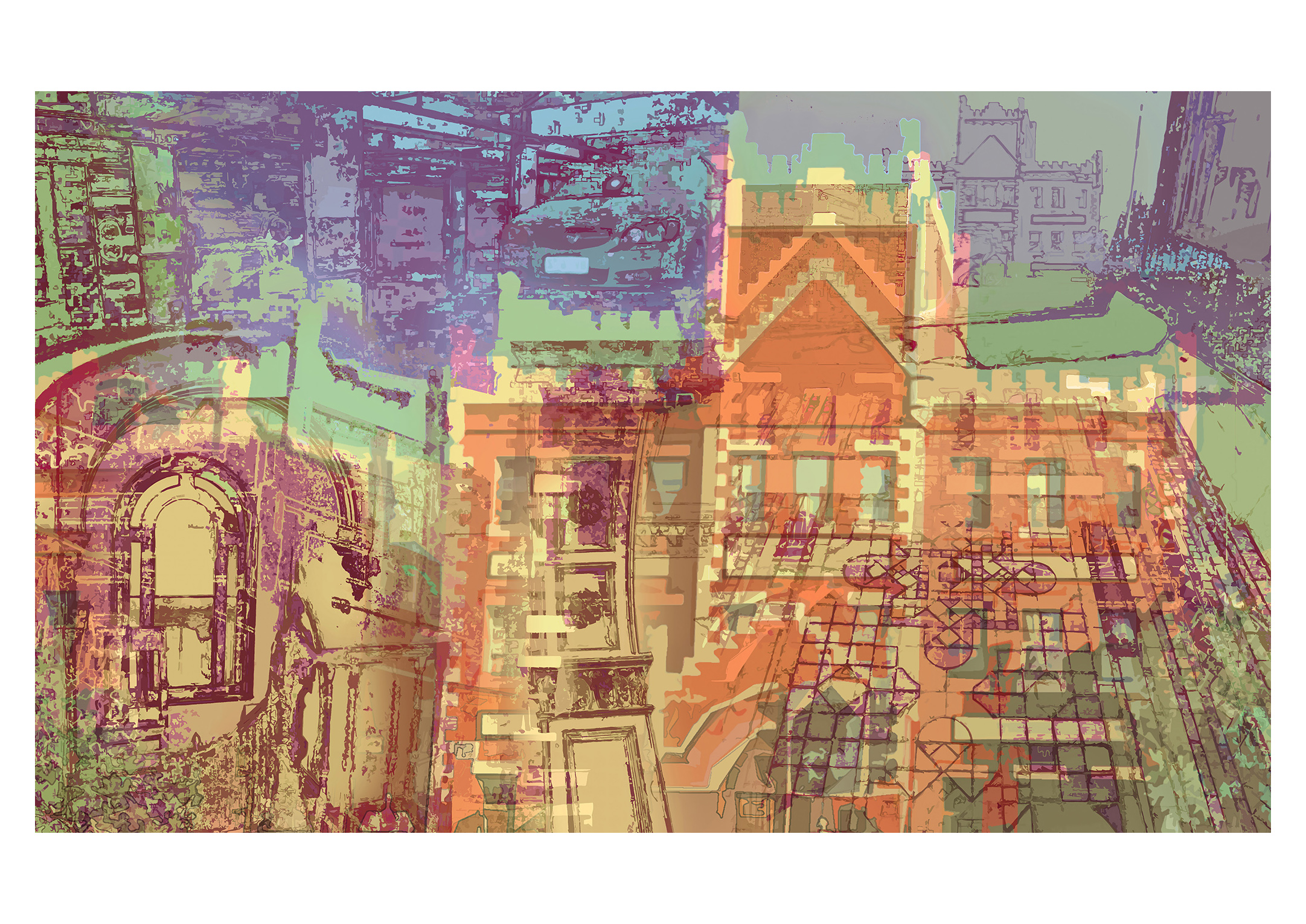
A reddish-orange structure dominates the foreground, its strong architectural presence set against a complex arrangement of teal, purple and green. In the distance, a castle-like silhouette rises among overlapping buildings, creating an impression of an urban landscape in which structures merge, shift and compete for attention. The rich colours and textured surfaces give the composition a sense of visual energy, while the imposing forms suggest permanence, authority and enclosure.
The work began with an encounter that challenged Marinelli’s first impression of a building in her neighbourhood. From the outside, its fortress-like appearance suggested a grand and imposing landmark. She later discovered that the building was public housing, prompting her to look more closely at its history and the reality of the spaces within.
Originally built in 1922 as the Salvation Army Training College, the building was later converted into public housing. Inside, Marinelli encountered a confronting scene: a flooded car park, broken doors and an electric blanket left on the floor. These details stood in stark contrast to the building’s distinctive architectural features and substantial history.
The discovery raised questions that went beyond the building’s condition. Why had this particular structure been purchased for public housing? What considerations had shaped the decision to repurpose it, and how suitable was it for the people who would call it home? Marinelli was left questioning the relationship between the building’s imposing appearance, its intended purpose and the conditions she had witnessed.
The artwork does not attempt to answer these questions, but it preserves the uncertainty and unease they provoked. The issue is not simply whether an old building can be given a new purpose, but whether that purpose is supported by appropriate living conditions, ongoing maintenance and care for its residents.
This tension lies at the heart of Fortress of Neglect. A fortress traditionally suggests strength, security and protection, yet the conditions Marinelli encountered challenged those associations. The building’s substantial exterior seemed to promise permanence, while the neglected details inside suggested a different reality. Its architecture became a metaphor for the distance that can exist between outward appearances and lived experience.
The work also invites reflection on the responsibilities involved in providing public housing. Buildings are more than architectural objects or assets to be repurposed; they are places where people live their daily lives. Their suitability, upkeep and condition have direct implications for comfort, dignity and wellbeing. When these considerations appear to be overlooked, questions arise about the priorities behind decisions affecting people’s homes.
Marinelli’s fragmented composition echoes this sense of contradiction. Buildings overlap and forms dissolve into one another, resisting a straightforward reading of the urban landscape. The vibrant palette draws the viewer in, while the title introduces a more troubling interpretation. The fortress becomes a symbol not simply of strength, but of the gap between the appearance of a place, the decisions that shape its use and the reality of life within it.
Fortress of Neglect is both a record of a personal discovery and a broader reflection on urban responsibility. It invites viewers to look beyond the surfaces of familiar buildings and question not only how they are maintained, but why they were chosen for particular purposes in the first place. Ultimately, it asks what it means to provide a home, and whether the needs of the people living inside are reflected in the decisions made on their behalf.
Reviews
There are no reviews yet.