Description
Lost Incinerator is a tribute to a remarkable piece of Sydney’s architectural heritage, demolished in 1992 as the city continued to transform. Through striking architectural forms, industrial imagery and the unexpected presence of a single orange poppy, Rose Marinelli reflects on the fragility of our built heritage and the lasting consequences of decisions that reshape the urban landscape.
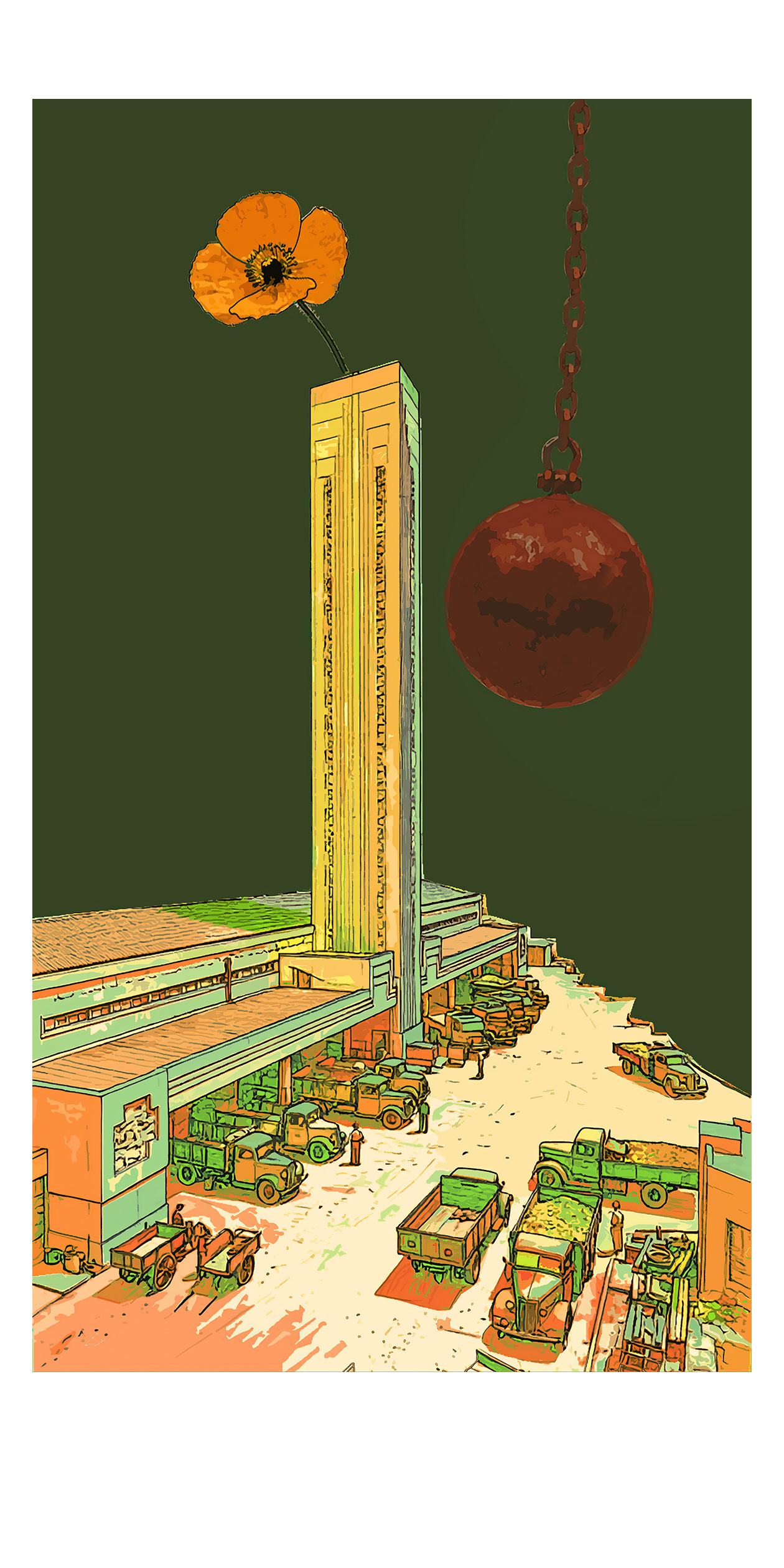
A slender, towering structure rises against a deep olive-green sky, its pale surfaces defined by strong outlines and carefully arranged blocks of colour. Below, an industrial complex unfolds amid a collection of vintage trucks and vehicles, recalling the working environment for which the building was created. Suspended beside the tower, a heavy, rust-coloured wrecking ball introduces a powerful sense of impending destruction. At the building’s summit, an orange poppy blooms, its delicate form offering a vivid contrast to the machinery and rigid geometry surrounding it.
The artwork pays tribute to the Pyrmont Incinerator, designed by architects Walter Burley Griffin and Marion Mahony Griffin. Completed in 1934, the incinerator was a distinctive example of their architectural vision, combining functional industrial design with forms influenced by ancient Mayan architecture, modernism and Cubism. Its decorative details incorporated references to the natural elements associated with its purpose: fire, air, water and earth. Rather than treating an industrial facility as merely utilitarian, the design gave the building a distinctive identity and an expressive architectural language.
Despite its architectural significance, the Pyrmont Incinerator was demolished in 1992 during a period of urban redevelopment. Its disappearance represents the loss of more than an industrial structure. It removed a distinctive landmark that connected the city’s working history with an ambitious vision of architectural design. Once gone, the building could no longer be experienced in its original form, leaving photographs, records and memories to preserve its place in Sydney’s history.
The wrecking ball in Marinelli’s composition makes this loss tangible. Its heavy, rust-toned form suggests the irreversible force of demolition, while the towering structure beneath it stands as a reminder of what once existed. The surrounding vehicles reinforce the building’s industrial purpose, placing it within the practical world of work and infrastructure rather than presenting it as an isolated architectural monument.
The orange poppy introduces another dimension to the work. Set against the dark sky and rigid geometry, the flower appears unexpectedly fragile, yet its vivid colour draws the eye towards the top of the structure. It can be read as a symbol of remembrance: a small, living form standing in for something that has disappeared. Where the wrecking ball represents destruction, the poppy suggests that the significance of a place can endure beyond its physical existence.
Through this contrast, Lost Incinerator considers the tension between redevelopment and preservation. Cities must change, but the removal of distinctive buildings raises questions about which parts of their history are considered worth keeping. Architectural heritage is not confined to grand civic monuments or celebrated residential buildings. Industrial structures can also embody innovation, craftsmanship and a particular moment in a city’s development.
Marinelli’s work is both remembrance and quiet protest. It does not simply mourn a demolished building; it asks viewers to consider the value of what is lost when architectural landmarks disappear in the name of progress. The composition preserves the incinerator in a new form, transforming its history into a visual statement about memory, destruction and the importance of recognising cultural significance before it is too late.
Lost Incinerator invites us to look again at the industrial structures that shape our cities and to consider the stories they hold. The building may be gone, but through art, its distinctive presence can continue to occupy a place in our collective memory.
Reviews
There are no reviews yet.